If you’ve ever visited a construction site, a shipyard, or a heavy equipment manufacturing plant, you’ve likely seen high-strength steel plates (HSSP) being used to build parts that need to stand up to extreme stress, impact, and corrosion. As a supplier who’s worked with this material for over a decade, I get asked this question all the time: “What is the hardness of high-strength steel plate?” The answer isn’t a single number—it’s a nuanced topic that ties to how the steel is made, what it’s used for, and why hardness matters for end-users. Let me break this down in plain, practical terms, not just textbook jargon. High-strength steel plate
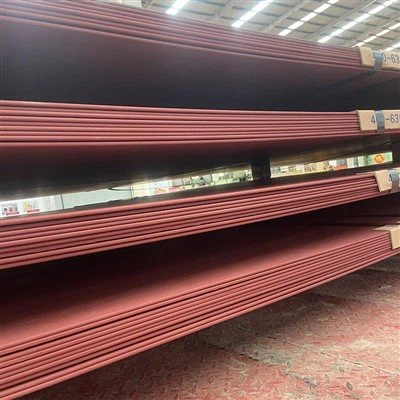
First, let’s start with a quick foundation: hardness in steel measures how resistant the material is to permanent indentation or scratching. For most steel products, we use standardized tests—like the Brinell Hardness Test (HBW), Rockwell Hardness Test (HRC), or Vickers Hardness Test (HV)—to get a consistent, repeatable reading. High-strength steel plates, unlike mild steel used in car bodies or household appliances, are engineered to be far harder, but their hardness range varies dramatically based on their grade and intended application.
Let’s talk about the core range first. The most common high-strength steel plates fall between 200 HBW and 500 HBW, which translates to roughly 20 HRC and 50 HRC on the Rockwell scale. But that’s just a general benchmark—some specialized grades go lower, some go much higher. For example, structural high-strength steel plates used in bridge beams, crane booms, or offshore rig decks are typically in the 250 HBW to 350 HBW range. This sweet spot balances hardness with toughness: if a plate is too hard, it becomes brittle and can crack under sudden stress, like a heavy load dropping on it. If it’s too soft, it’ll deform or wear out too fast, which is useless for heavy-duty work.
Now, why does hardness matter for these applications? Let’s use a real example: a ship’s hull plate. Ships sail through saltwater, take repeated impact from waves and debris, and carry thousands of tons of cargo. If a hull plate is too soft, it’ll dent easily, even from a small collision with a floating container or a piece of ice. If it’s too hard, a hard impact might cause a crack that spreads quickly, leading to a dangerous breach. That’s why marine-grade high-strength steel plates are calibrated to around 280 HBW—hard enough to resist dents, tough enough to resist cracking.
Another grade: quenched and tempered (Q&T) high-strength steel plates, which are some of the toughest we supply. These go through a heat treatment process where they’re heated to a high temperature, then rapidly cooled (quenched), then reheated to a lower temperature (tempered) to reduce brittleness. Q&T plates hit much higher hardness levels, usually between 400 HBW and 500 HBW, or 42 HRC to 52 HRC. These are for heavy equipment like excavator arms, bulldozer blades, or armor plating for military vehicles. Here, hardness is non-negotiable—they need to resist abrasion from rocks, dirt, or even projectiles, but the tempering step keeps them from shattering when hit.
Wait, but I’ve heard some customers mix up hardness and strength, and that’s a common mistake. Hardness and tensile strength (the amount of stress a material can handle before breaking) are closely related, but not the same. For steel, there’s a rough rule of thumb: 1 HBW is roughly equal to 3.45 megapascals (MPa) of tensile strength. So a 300 HBW plate has a tensile strength around 1035 MPa, which is 3 to 4 times stronger than mild steel (which is around 200 MPa and 110 HBW). That’s why high-strength steel plates can hold so much more weight without bending—their hardness is a direct indicator of that strength.
But here’s a critical point: hardness isn’t one-size-fits-all. A 300 HBW plate for a bridge is way different from a 300 HBW plate for a storage tank. Wait, no, actually—let’s clarify: some high-strength plates are “ultra-high-strength,” which go above 500 HBW, up to 600 HBW, but those are niche products. They’re used for specialized applications like deep-sea drilling components or high-pressure vessels. But as a supplier, I have to warn customers not to just pick the hardest plate they can find. If a customer is building a low-pressure storage tank for grain, a 500 HBW plate is unnecessary, more expensive, and actually harder to weld. Welding high-hardness steel requires special procedures—preheating, low-hydrogen electrodes, slow cooling—to prevent cracking. If you use an overly hard plate for a simple application, you’re wasting money and introducing avoidable risks.
Now, let’s talk about how we test hardness in our own facility. We don’t just take a single reading—steel plates have a microstructural gradient: the outer surface is often harder than the core, because of how it’s rolled or coated. So we test multiple points: the surface, 1mm below the surface, and the center of the plate. That tells us if the plate is uniform in hardness, which is key for consistent performance. A plate with uneven hardness might crack during fabrication, like when we bend it into a crane arm shape. If one area is harder than another, the bend will start at the weakest spot.
I also get asked if hardness changes over time, especially in harsh environments. The short answer: yes, it can, but it’s usually not a big concern if the plate is the right grade. For example, plates used in saltwater environments will experience corrosion, and as corrosion eats away at the surface, the exposed layer might lose some hardness. But marine-grade plates are often coated with paint or zinc to slow that down. On the other hand, plates used in abrasive environments, like mining equipment, will actually gain hardness over time? No, wait—no, abrasion wears down the surface, so if it’s wearing a softer outer layer, you expose the core. But if the plate is designed for abrasion, its surface is intentionally hard to resist that wear. So proper grade selection is key to long-term hardness stability.
Let’s also bust a myth: higher hardness always means better quality high-strength steel plate. That’s not true. A plate with 500 HBW might look impressive, but if it’s not properly tempered, it’s brittle, and will crack when exposed to cold temperatures. For applications in cold climates, like northern Canada or Alaska, we supply plates with hardness around 320 HBW, not 450 HBW, because those grades are tested for impact resistance at low temperatures. A 450 HBW plate that’s not cold-tough might snap in half when the temperature drops below -40°F, which is a huge safety risk. That’s why as a supplier, we don’t just sell plates based on hardness numbers—we work with customers to match hardness to their exact operating conditions.
Now, how do we use this information in practice with our customers? Last year, a mining equipment manufacturer came to us looking for a plate for dump truck beds. They’d been using a 350 HBW plate and seeing excessive wear, with the beds thinning out after 12 months. We recommended a 450 HBW Q&T plate, and also adjusted the tempering to make sure it was tough enough for the constant impact of rocks. Their beds now last 18 months, and they reported 25% less downtime for repairs. That’s the difference between picking a hardness number off a spec sheet and understanding what hardness means for real-world use.
Another customer was a small construction company building a new workshop. They asked for the hardest plate we had, thinking it would make the floor super durable. We explained that a 500 HBW plate for a floor is overkill—they’d pay 3 times more than needed, and it would be harder to cut and weld for the workshop’s frame. We recommended a 250 HBW structural high-strength plate, which is hard enough to support heavy equipment and easy to work with for their crew. That’s the kind of practical advice we pride ourselves on giving, not just selling a product.
So to sum up: the hardness of high-strength steel plate isn’t a single value. It ranges from roughly 200 HBW for lower-strength structural grades up to 500+ HBW for heavy-duty, abrasion-resistant or quenched and tempered grades. The right hardness depends on your application, the operating environment, and the need to balance strength, toughness, and wear resistance. Too hard, and you risk brittleness and fabrication issues; too soft, and you get premature wear or deformation.

If you’re working on a project that requires high-strength steel plates—whether it’s a bridge, ship, heavy equipment, or industrial structure—you don’t have to navigate the hardness specs alone. We’ve helped hundreds of clients find the right plate for their needs, balancing hardness, strength, and cost to get the best long-term performance. We can provide detailed hardness test reports for any grade, answer questions about fabrication requirements, and even suggest adjustments if your project’s conditions change. Whether you’re a small contractor or a large manufacturing firm, we’re here to help you make an informed choice that keeps your project safe, durable, and cost-effective. Reach out to us to discuss your specific needs and get a custom consultation.
Sub-sector components References:
- ASM International. (2019). Hardness Testing of Steel. Metals Handbook, Volume 1: Properties and Selection: Irons, Steels, and High-Performance Alloys.
- British Standards Institution. (2020). BS EN 10025-6: Hot-rolled products of structural steel. Technical delivery conditions for flat products of high yield strength structural steels in the quenched and tempered condition.
- Dieter, G. E. (2013). Mechanical Metallurgy, 3rd Edition. McGraw-Hill Education.
- International Organization for Standardization. (2021). ISO 6506-1: Metallic materials – Brinell hardness test – Part 1: Test method.
- NACE International. (2018). Corrosion Resistance of High-Strength Steel Plates in Marine Environments. CORROSION 2018 Conference Proceedings.
Shandong Baohua Abrasion Resistant Steel Co., Ltd.
Shandong Baohua Abrasion Resistant Steel Co., Ltd. is one of the leading high-strength steel plate manufacturers and suppliers in China. We warmly welcome you to buy high quality high-strength steel plate in stock here from our factory. For customized service and free sample, contact us now.
Address: 2nd Gongye Road, Lanshan Economic Development Zone , Linyi City,Shandong Province, China
E-mail: baohuasteelmkt@gmail.com
WebSite: https://www.baohua-steel.com/
