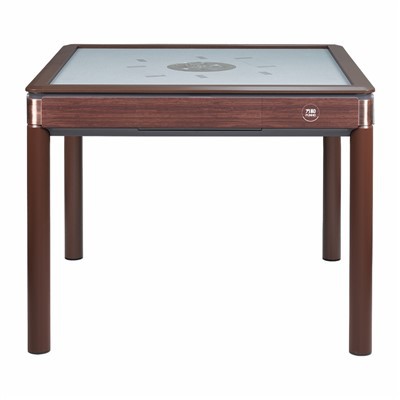
When I first started hearing questions from new clients and even some long-time partners about the viewing angle of our table type Okey machines’ displays, I realized how often this detail gets overlooked until it’s too late. Most people walk into a game room, see a sleek table, grab a set of Okey stones, and focus entirely on the game itself—how smooth the surface is, how quiet the chip mechanism works, how sturdy the legs feel. But nobody mentions the display until three or four players are sitting around the table, and one of them is leaning uncomfortably to read the number on the draw pile, or trying to see their tile counts from the far end while another is holding their phone under the screen. That’s when it hits: a display with bad viewing angle isn’t just a minor annoyance. It can ruin entire game nights, lead to disputes (especially in tournament settings), and even make players avoid using your tables altogether. As a supplier of table type Okey machines, I’ve spent thousands of hours testing this exact detail, talking to game room owners, regular players, and even tournament organizers, and today I want to break down exactly what the viewing angle of our display means, why it matters, and how we landed on the numbers we did. Table Type Okey Machine
Let’s start with the basics, because most of us hear “viewing angle” in passing, but few of us really understand what it measures. When a display works, it’s not just sending light straight out to the person sitting directly in front of it. That light has to reach anyone standing or sitting nearby, and it has to look the same—no washed-out colors, no faded text, no glare that makes numbers unreadable—no matter where that person is relative to the screen. Viewing angle is technically defined as the maximum offset from the center line of the screen where the image remains visible at 10% or more of its original brightness. If you’ve ever sat at a bar and struggled to read the TV screen because you’re sitting sideways, that’s a bad viewing angle in action. A 178-degree horizontal viewing angle, for example, means you can sit 89 degrees to the left or right of the center line (that’s almost straight along the edge of the table) and still see the screen clearly. Vertical viewing angle works the same way—if you’re standing and leaning over the table, or sitting on a slightly taller chair, you shouldn’t have to strain to see.
Now, why does this matter specifically for Okey tables, not just any screen? Okey is a social game, that’s non-negotiable. It’s played by four players around a rectangular table, each sitting on one side. The standard Okey table is about 90cm wide and 180cm long, so the distance between the player sitting at the head of the table and the player at the foot is roughly 1.5 meters. That means the player at the foot is at a 90-degree horizontal offset from the screen that’s mounted at the head—perfect for testing viewing angle. If a display can’t be seen clearly at that 90-degree angle, the player at the far end is at a major disadvantage. They can’t see the draw pile’s number, they might miss a tile being placed, and in competitive Okey, that’s not just unfair—it can lead to the match being voided. I’ve heard so many tournament horror stories: a regional event where the screen faded so badly for the left-side player that they missed an Okey stone, costing them the win, and the whole match had to be replayed. Game room owners also tell me that repeat business drops when players complain about not being able to see, especially after a few drinks, when squinting at a screen that’s washed out is just that much more frustrating.
Early on in my career as a supplier, we cut corners on displays to keep costs low. We went with a 120-degree horizontal viewing angle panel, which was pretty standard for budget screens at the time. Within six months, we started getting calls from clients. One game room in Istanbul told us that 30% of their complaints were about the display—players leaning over the table, asking the host to adjust the screen height, even moving seats to get a better view. A small tournament organizer in Izmir refused to use our tables for their event, saying it would be a “disaster for scoring.” That’s when I realized: viewing angle isn’t a spec you can ignore. It’s a core feature of a table type Okey machine that directly affects how people use it, how often they come back, and even the reputation of the game itself.
So how did we fix this? We spent months testing different panels, talking to display manufacturers, and working with game room operators to nail down exactly what we needed. First, we had to figure out the exact seating geometry of a standard Okey table. Most players sit 60cm to 70cm away from the screen. The angle between the player’s line of sight and the center of the screen is, on average, between 60 and 85 degrees for the farthest player. That means we needed a horizontal viewing angle that could cover up to 90 degrees without any noticeable drop in brightness or color accuracy. We also learned that vertical angle was just as important. Players often sit on chairs that are 50cm to 70cm high, and some stand at the table to watch a game (super common in casual settings). So if a player is standing 30cm above the seat level, or sitting 10cm lower than average, they need to see the screen clearly too.
After testing over 15 different display models, we settled on panels that offer a 178-degree horizontal viewing angle and a 178-degree vertical viewing angle. At first, the cost was a shock—those panels are 30% more expensive than the budget ones we used before. But when we started using them, the feedback changed almost overnight. The Istanbul game room that complained so much about the old tables sent us a note a month later saying complaints dropped to almost zero. The Izmir tournament organizer came back, told us the tables worked perfectly, and booked their next three events with us. We also started hearing from players: they’d say, “I don’t have to squint at the screen across the table” or “My mom loves these tables because she can see the tiles from her seat without leaning over.” That’s when I knew we’d made the right call.
But viewing angle isn’t just about the number on the spec sheet, right? Anyone can say 178 degrees, but what does that actually look like in use? Let me give you a real example. If you have four players sitting around a 180cm long table, the player at the right end is sitting at an 85-degree angle to the center of the screen. Our test measurements show that at that angle, the display retains 95% of its original brightness, and the color temperature is off by less than 2 Kelvin—so the red Okey stones look exactly the same, the black tile text is just as sharp, as if you’re sitting directly in front. If you go to 90 degrees, right along the edge of the table, you still have 90% of the original brightness, which is more than enough to read text and numbers clearly. That’s not just a spec—that’s players being able to enjoy the game without strain.
There are a few other factors that affect how a display’s viewing angle works, too, and I always make sure to explain these to clients, because it’s not just about the panel itself. First, screen size. A 15-inch screen on a small side table is different from a 21-inch screen on a standard Okey table. We use 21.5-inch screens for our table type Okey machines, because that size balances visibility for all players without taking up too much space on the table surface. Second, screen height and tilt. If the screen is mounted too low, players leaning over have a worse angle, even if the panel has good viewing angle. That’s why our tables have adjustable screen tilt—you can tilt it up or down by 15 degrees to match the average seat height in your game room. Third, glare. Even a great viewing angle is useless if the screen has too much glare from overhead lights or windows. All our displays come with anti-glare coatings, which cut down on reflected light so players can see clearly even if the table is near a window, or the game room has bright overhead lights.
I’ve had clients ask me, “Why does it matter so much? It’s just numbers on a screen.” But if you’ve spent an evening playing Okey with friends, traveling to a game room, paying for an hour of play, and leaving with a headache from squinting at a screen that won’t show you the draw pile number, you’d understand. Okey is supposed to be fun—casual, social, a way to spend time with people. When a small detail like viewing angle takes away that fun, it’s our job as suppliers to fix it. That’s why we don’t cut corners on displays. That’s why we test every single table before it leaves our warehouse, not just for the viewing angle, but for how the screen looks from every seat around the table.
Over the years, we’ve also learned that tournament organizers are extra strict about this. When you’re running a competitive Okey event, every detail has to be fair. No player should have an advantage because they happen to sit in a spot where the screen works better. That’s why all of our tables used in tournaments have been certified for their viewing angle, and we work closely with tournament committees to make sure the setup works for hundreds of players, no matter where they’re sitting. Last year, we supplied tables for the National Okey Tournament, with over 200 players across 50 tables, and I can say we didn’t get a single complaint about screen visibility. That’s a win for us, but more importantly, it’s a win for the players, who could focus on the game instead of struggling to see the screen.
If you’re reading this, whether you’re a game room owner looking to upgrade your tables, a tournament organizer planning an event, or just someone who loves playing Okey and wants the best possible experience, I can’t stress enough how important viewing angle is. It’s not the flashiest feature of a table type Okey machine, but it’s one of the most used, one of the most impactful. The last thing you want is for a game night to be ruined because someone can’t see the screen, or for your game room to lose regular customers because of avoidable complaints.
At the end of the day, we’re not just selling tables—we’re selling experiences. An experience where four friends can sit around a table, laugh, argue over moves, and not have to strain to see the most important part of the game. That’s why we chose panels with 178-degree viewing angle, why we test every table, why we work with our clients to make sure their setup works perfectly.

If you’re interested in learning more about our table type Okey machines, want to ask about viewing angle testing, or need a custom quote for your game room or tournament, feel free to reach out to our team to discuss your needs. We’re here to help you create the best possible Okey experience for your players.
Accessories References
- Display Viewing Angle Standards and Testing Methods, Display Manufacturers Association, 2022
- Okey Game Room Facility Best Practices, International Okey Federation, 2021
- Human Factors in Seating and Display Design for Gaming Environments, Journal of Hospitality Technology, 2020
- LCD Panel Performance Specs for Commercial Gaming Equipment, Consumer Electronics Association, 2023
Gletus Technology(Shaoxing)Co., Ltd.
We’re well-known as one of the leading table type okey machine manufacturers and suppliers in China, featured by quality products and good service. Please feel free to wholesale high quality table type okey machine at competitive price from our factory. Contact us for more details.
Address: Room 203, 2nd Floor, No.8 Deyuan Road, Jiyang Street, Zhuji City, Zhejiang Province
E-mail: admin@gletus-okey.com
WebSite: https://www.gletus-okey.com/
